


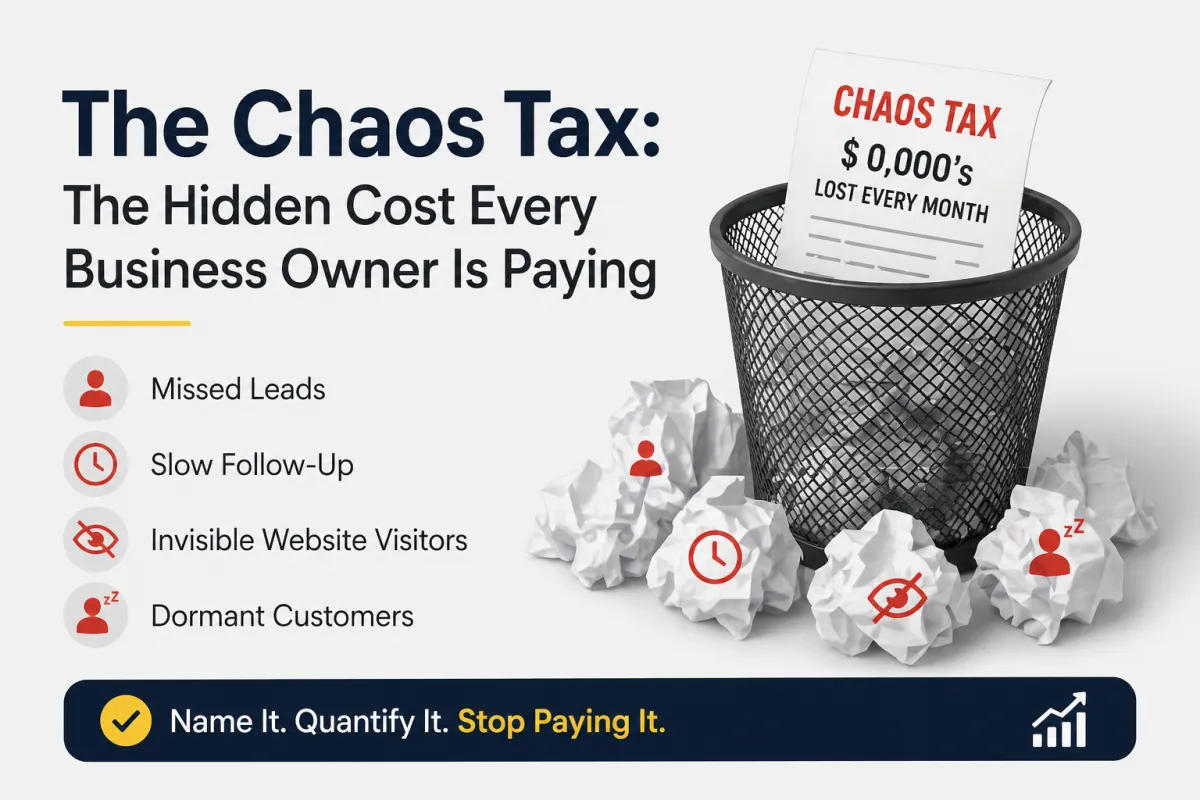
The Chaos Tax: The Hidden Cost Every Business Owner Is Paying - Copy
The Chaos Tax: The Hidden Cost Every Business Owner Is Paying (But Nobody Talks About)
By Jonathan Munsell
There's a tax on your business that doesn't show up on your P&L.
Your accountant has never mentioned it. The IRS doesn't collect it. And there's no line item for it at the end of the year.
But you're paying it. Every single day.
I call it the Chaos Tax.
And after 30 years of building businesses — restaurants, tech startups, an international franchise with 300 locations — I can tell you with complete confidence: the Chaos Tax is the single most expensive thing most business owners never see coming.
What Is the Chaos Tax?
The Chaos Tax is what you pay to run a business without designed systems.
It doesn't look like one big catastrophe. It looks like a thousand small ones, happening every week, quietly bleeding revenue in ways you've learned to accept as normal.
It looks like this:
A potential customer visits your website at 11pm on a Tuesday. They look at your services. They read your pricing page. They almost fill out the contact form — and then they close the tab and go to sleep.
By morning, they've forgotten your name. By noon, they've called your competitor.
You never knew they were there. You had no way to follow up. And you just lost a customer you spent money to attract.
That's the Chaos Tax.
Or it looks like this:
A lead comes in at 3pm on a Friday. You're in the middle of a job. You get to it Monday morning. Too late — they already moved on. Studies show your contact rate drops by 100 times after the first hour. One hour.
That's the Chaos Tax.
Or this:
Your best employee — the one who knows how everything works, who follows up with customers, who remembers the details — puts in their two weeks notice. And suddenly you realize that your entire follow-up process lived in their head. Not in a system. Not in software. In a person who just handed you their resignation.
That's the Chaos Tax.
Why Business Owners Don't See It
Here's the uncomfortable truth about the Chaos Tax: it's invisible because it's made up of things that didn't happen.
The customer who didn't come back.
The lead who didn't convert.
The referral that was never asked for.
The review that was never collected.
The past customer who bought from your competitor because you stopped showing up.
You don't feel the sting of any individual one. It's not like losing a wallet — where you notice immediately, feel the pain, and take action.
The Chaos Tax is more like a slow leak in a tire. The car still runs. You still get where you're going. But every day you're losing a little pressure, burning a little more fuel, wearing the rubber down a little faster. Until one day — usually at the worst possible moment — everything goes flat.
And the most dangerous part? The chaos feels normal.
We've all been trained to wear busyness like a badge of honor. Hustle culture has convinced an entire generation of business owners that the struggle is the point. That if you're not grinding, you're not serious. That chaos means you're busy, and busy means you're successful.
It doesn't.
Chaos means your systems are broken. Or more often — that you don't have systems at all.
What the Chaos Tax Actually Costs
Let me give you a number.
If your website gets 100 visitors a week and you convert 3% of them — you're getting 3 leads.
The other 97 people? Gone. Invisible. You have no idea who they were, what they looked at, or how close they came to calling you.
If your average customer is worth $2,000 — those 97 invisible visitors represent up to $194,000 in potential revenue. Per week. From traffic you're already paying to attract.
That's not a hypothetical. That's the math of a broken capture system. And it's happening in businesses everywhere, every week, without anyone noticing.
Now multiply that across 52 weeks. Across slow response times. Across leads who never got followed up with. Across past customers who never heard from you again. Across reviews that were never requested. Across referrals that were never asked for.
The Chaos Tax isn't a rounding error. For most businesses, it's the difference between struggling and thriving.
The Owner Bottleneck
There's a specific version of the Chaos Tax that hits business owners harder than anything else. I call it the Owner Bottleneck.
It happens when you are the system.
You're the one who knows when to follow up and who to follow up with. You're the one who remembers what the customer said in the last conversation. You're the one who knows when to send the proposal, when to check in, when to ask for the review.
Which means when you're on a job, the follow-up doesn't happen.
When you're on vacation, the sales process stops.
When you're sick, the whole machine grinds to a halt.
The most dangerous words in business are: "I just need to handle this myself."
Not because you're not capable. You almost certainly are. But because no human being can be consistent, fast, and available at all hours, every day, across every customer touchpoint — and also run a business at the same time.
When you are the system, you can't scale. You can't step away. You can't get sick. You become a hostage to your own business.
And that's the deepest, most expensive version of the Chaos Tax there is.
The Three Places the Chaos Tax Hits Hardest
After working with hundreds of business owners across dozens of industries, I've found that the Chaos Tax shows up in the same three places almost every single time.
1. The Invisible Traffic Problem
The average business converts about 3% of its website traffic. The other 97% leaves without a trace.
Most business owners think this is just how it is. It's not. It's a system problem. The leads were there — they just had no way to capture them, identify them, or follow up with them.
2. The Follow-Up Failure
Studies consistently show that most sales happen between the 5th and 12th contact. Most businesses stop at 2.
Not because they don't care about the customer. Because they don't have a system that keeps following up automatically when life gets busy and the manual follow-up falls through the cracks.
3. The Dormant Customer Problem
The easiest sale you'll ever make is to someone who already bought from you, already had a good experience, and already trusts you.
And yet most businesses have a database full of past customers they haven't contacted in 12 months. Sometimes longer. There's no reactivation system. No check-in sequence. No reason given for those customers to come back.
So they don't. Not because they're unhappy. Because nobody stayed in touch.
What Fixes the Chaos Tax
Here's what I've learned after 30 years of building businesses and watching most of them struggle with the same problems:
The Chaos Tax is not a hustle problem. You can't outwork it.
It's not a motivation problem. You can't out-discipline it.
It's an architecture problem. And the only fix is designing systems that run without you.
A real system doesn't require you to remember to run it.
A real system produces consistent results whether you're present or not.
A real system gets smarter over time — capturing more data, triggering better follow-up, revealing more patterns.
When you build systems — and then layer AI and automation on top of those systems — something shifts.
Your website starts identifying visitors instead of watching them disappear.
Your follow-up happens automatically, within minutes, at the right moment.
Your past customers hear from you on a schedule that doesn't depend on you remembering to call.
Your reviews build themselves. Your referrals become a process instead of an accident.
That's not hustle. That's architecture.
And the difference between a business built on hustle and a business built on architecture is the difference between a job with overhead and a company that actually works.
The Shift That Changes Everything
The business owners I've seen make the biggest leaps aren't the ones who worked hardest. They're the ones who stopped and asked a different question.
Not: How do I work harder?
But: What would happen in my business if I couldn't show up for 30 days?
If the honest answer is "everything would fall apart" — you don't have a business. You have a job that requires your constant presence to function.
The goal isn't to eliminate you from the equation. It's to design a business where your time and attention go to the highest-leverage things only you can do — while the systems handle everything they're capable of handling.
That's what I call the AI Way.
Not AI as a gimmick. Not AI as a chatbot. AI as the enforcement layer on top of intentional, well-designed systems. The architect sets the blueprint. The AI makes sure the work gets done.
When you build that way — the Chaos Tax disappears. Not because you worked harder. Because you finally built something that works while you're not looking.
Your Assignment Right Now
Before you read another article, watch another video, or buy another tool — answer this honestly:
What happens to a potential customer who visits your website and doesn't contact you?
Do you have a way to identify them?
A system to follow up with them automatically?
Any way to stay in front of them through their decision process?
If the answer is no — you've just found your Chaos Tax.
And now you know exactly where to start fixing it.
Jonathan Munsell is the author of The AI Way: How Business Owners Win in the AI Automation Economy and the founder of Success Systems LLC. He teaches business owners how to build systems that compound — using AI to enforce architecture, not replace it.
Ready to stop paying the Chaos Tax? Start with the free Revenue Recovery Playbook — 9 industries, 9 real businesses, actual numbers: identifyly.com/revenue-recovery-playbook
Or join the free Marketing Made Easy community and get the tools to start fixing it today: marketingmadeeasy.app/free

Explore a better way to grow
(919) 646-3322
(919) 646-3322

The best platform to manage a Business's Growth, Lead generation, Sales Process, Follow-up, Two-way Communication, Pipeline, Automated Scheduling, Sales Funnels, Social Media Posting, Reviews and So Much More...
2474 Walnut St
Suite 309
Cary, NC 27518
All Rights Reserved
© 2026 - Success Systems LLC
This site is not part of the Facebook website or Facebook Inc. Additionally, This site is NOT endorsed by Facebook in anyway. FACEBOOK is a trademark of Facebook, Inc.
DISCLAIMER: If you do nothing, you can expect nothing. Your results will vary and depend on many factors… including but not limited to your background, experience, and work ethic. All business entails risk as well as massive and consistent effort and action. If you’re not willing to accept that, please DO NOT APPLY FOR OUR PROGRAM.
We’re on a mission to build a better future where technology creates good jobs for everyone.